All members of a religious, political, etc. belief system run the gamut on their individual practices.
I will primarily speak from a Christian perspective, but at least some of the same logic can be applied to Judaism and Islam.
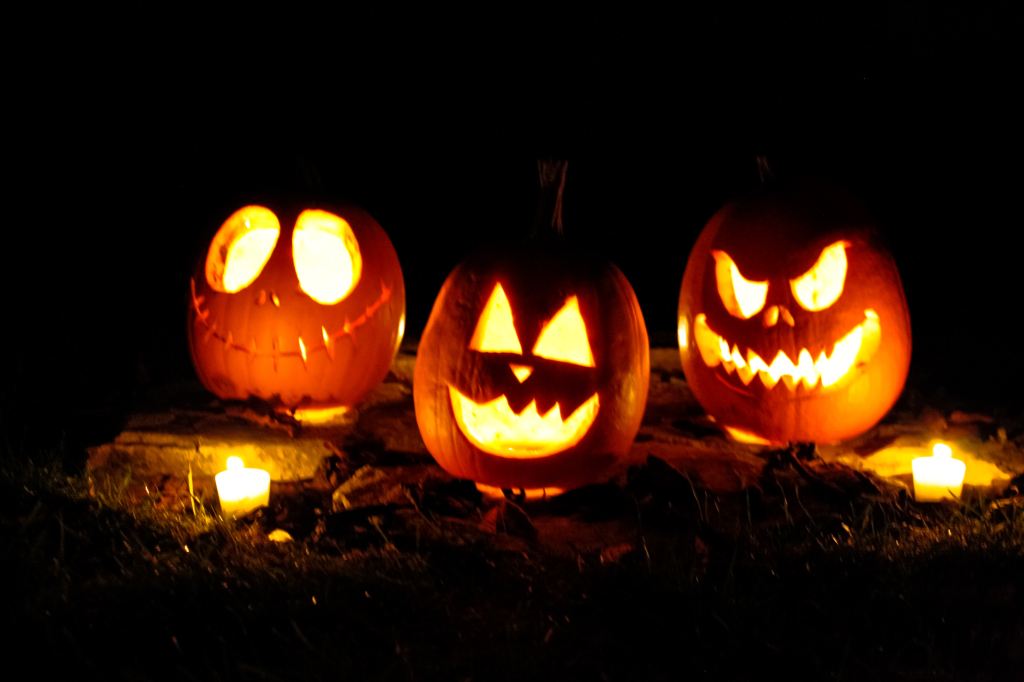
Some Christians won’t celebrate Halloween because of its pagan roots. Many churches embrace the fun parts of Halloween, with members dressing in costume and hosting trunk or treat events. Some Christians fully embrace the ‘spooky season’ magic by decorating with jack-o-lanterns and binge-watching horror movies. Others still fall somewhere in the middle – not opposed to the light-hearted parts, but taken aback by the ten-foot-tall inflatable skeleton in their neighbor’s yard.
So, I thought it’d be interesting to do some research and offer my two cents.
The origins of Halloween
According to the Library of Congress, the Halloween holiday has its roots in the ancient Celtic festival of Samhain (a Gaelic word pronounced “SAH-win”), a pagan religious celebration to welcome the harvest at the end of summer, when people would light bonfires and wear costumes to ward off ghosts.
This day marked the end of summer and the harvest and the beginning of the dark, cold winter, a time of year that was often associated with human death. Celts believed that on the night before the new year, the boundary between the worlds of the living and the dead became blurred. On the night of October 31 they celebrated Samhain, when it was believed that the ghosts of the dead returned to earth.
By A.D. 43, the Roman Empire had conquered the majority of Celtic territory. In the course of the 400 years that they ruled the Celtic lands, two festivals of Roman origin were combined with the traditional Celtic celebration of Samhain.
By the 9th century, the influence of Christianity had spread into Celtic lands, where it gradually blended with and supplanted older Celtic rites. In A.D. 1000, the church made November 2 All Souls’ Day, a day to honor the dead. It’s widely believed today that the church was attempting to replace the Celtic festival of the dead with a related, church-sanctioned holiday. (Source)
Do the origins matter?
The following video succinctly explains how Halloween evolved from a pagan holiday to a Christian holiday to a secular holiday –
Seeing how the holiday has developed and changed over time, here is the question that rises to the top: do the origins actually matter?
Arguments against Halloween
Since Christians are called to be the light of the world, and since the Bible repeats the phrase “Do not fear” many times, and since Jesus came to earth to conquer sin and death, one can argue there is no reason Christians should be involved with a holiday centered around dark themes/imagery, the undead, and scary creatures.
Halloween is a demonic pagan celebration. It is believed that on Halloween, the door between the realm of demons (2nd heaven) and the living is opened, and all manner of evil can manifest itself among the living. October 31st is a “holy day” for Satanic worshipers, witches, warlocks and demons. Satanists and devil worshipers put as much importance on Halloween as Christians do on Resurrection Sunday, when Jesus Christ conquered death. (Source)
Some Wiccans (witches) and Satanists celebrate the holiday with its original meaning and intentions – which lends support to the argument that the pagan origins do matter.
Here’s a testimony from an ex-witch-turned-Christian on the dangers of Halloween –
In the Jewish Torah (part of the Old Testament to Christians), idolatry/worship of other gods is warned against many times. Punishments for these offenses were brutal and unrelenting. Throughout the Old Testament, the Israelites incur God’s wrath repeatedly by straying from His commandments and aligning with other gods and religious practices.
Also in the Torah, witches, mediums, and sorcery are condemned.
One might argue that God as represented in those ancient texts has zero tolerance for pagan practices, even if they have been watered down.
A new era after Jesus
For professing Christians, the ‘new era’ of the world ushered in by Jesus’s life, death, and resurrection – an era where all people including Gentiles are welcome into the family of God – may be a factor to consider.
Jesus came not to abolish the Law of Moses but to fulfill it, becoming the Lamb of God that saves all humanity, setting us free from the need for sin sacrifices and from many of the Old Testament commandments.
Paul, the main missionary to Gentiles in the New Testament, insists that Gentiles do not have to circumcise the men or carry on other Jewish traditions to receive God’s gift of salvation through Jesus. In Acts 15, the council of Christian elders in Jerusalem advised Gentile believers –
It seemed good to the Holy Spirit and to us not to burden you with anything beyond the following requirements: You are to abstain from food sacrificed to idols, from blood, from the meat of strangled animals and from sexual immorality. (Acts 15:28-29)
If Gentiles are embraced in the family of God, and many Gentiles in Biblical times were pagans, then I wonder: if a person with pagan roots may be redeemed, can a tradition with pagan roots also be redeemed?
Hyperconsumerism
I believe one of the most insidious parts of Halloween in the 21st century is the promotion of hyperconsumerism. Our obsession with shopping and constantly acquiring MORE, at the expense of our environment and low-wage workers, is appalling.
I would argue that hyperconsumerism, the overconsumption of goods, is the greatest form of idolatry in the modern world.
In 2021, Americans spent a record $10.1 billion on Halloween, the second biggest retail event of the year. (Source)
And what do you think is the first biggest retail event of the year? Do I even need to say it? … Yup, it’s Christmas. The stats on Christmas for spending and waste generated are shocking and disappointing, to put it mildly.
In Genesis 1:28 God gives mankind its first stewardship assignment. It says, And God blessed them. And God said to them, ‘Be fruitful and multiply and fill the earth and subdue it, and have dominion over the fish of the sea and over the birds of the heavens and over every living thing that moves on the earth (ESV).’ In this short verse God gives us three earth stewardship directives: (1) Fill the earth with people; (2) Subdue the earth or bring it under control; (3) Have dominion over all living creatures. This three-pronged directive provides us with a solid biblical foundation and basis for a responsible, God-centered, approach to creation care. How are you caring for the small portion of God’s creation that He has entrusted you to manage? Think about it. (Source)
Click here to read horrifying stats about our waste problem.
Final thoughts
Is Halloween evil? Evil is in the eye of the beholder. Its original pagan roots go against many religious teachings.
[SN: Hyperconsumerism is evil. Yet, no one seems worried about that part. SMH.]
The question then becomes, do the pagan roots really matter? One can argue they are still relevant, if witches celebrate Halloween. But…
Should religious people celebrate it? I think it’s up to individual discretion. As with Jewish Christians vs. Gentile Christians in the Bible, people’s conviction or comfortability level with certain things may vary.
Jewish Christians believed they should circumcise men to honor the covenant God made with Abraham, and Gentile Christians didn’t. But neither group was completely right or completely wrong. Then and now, we all should behave in ways that we feel honor God.
If wearing a scary mask feels contradictory to being a light, that’s understandable. On the other hand, many people view wearing a costume as superficial, and it has no greater meaning.
Would God approve of me watching a horror movie? How about me decorating with spooky decor? How about me visiting a haunted house attraction?
Many religious folks might earnestly say that yes, it matters. Because it matters what you set your sights on, how you spend your time, what you allow to influence you.
I respect and even agree with that sentiment…to an extent.
I think God knows my flawed but striving heart, and that’s what really matters. But nit-picking questions like I presented are a fixation for many Christians. I would advise people to be careful because obsessing over small issues leads to legalism. Many people have to deconstruct their beliefs when they finally realize there is no end; the well of legalism is bottomless, and the burden of living with so many rules often becomes too much to bear. This is what I’ve learned firsthand.
Then again, one might say I’m being willfully ignorant. The ex-witch in the video above asserts that, even if we celebrate Halloween with naivete and pure intentions, we still align ourselves with a mass ritual of dark magic.
I know some people will be disappointed by my noncommital answer and wish I would draw a definitive line in the sand. I don’t feel qualified to speak prescriptively on the matter. But I hope this post provided you with more information to help you draw your own conclusion.
I’ll leave off with one more article –
Thank you for reading. Please let me know your thoughts in the comments below.






 Retrospective Lily
Leave a reply to Lily Pierce Cancel reply