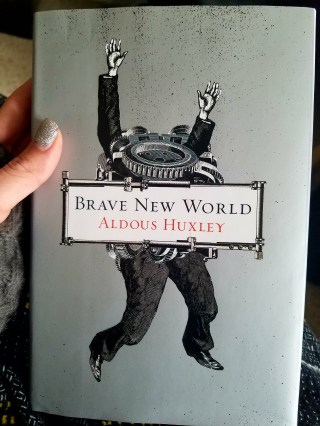
Hi, friends. Today, we’re looking at a twentieth century classic by a lesser known author. This dystopian fiction is a quick but thought-provoking read.
Brave New World by Aldous Huxley
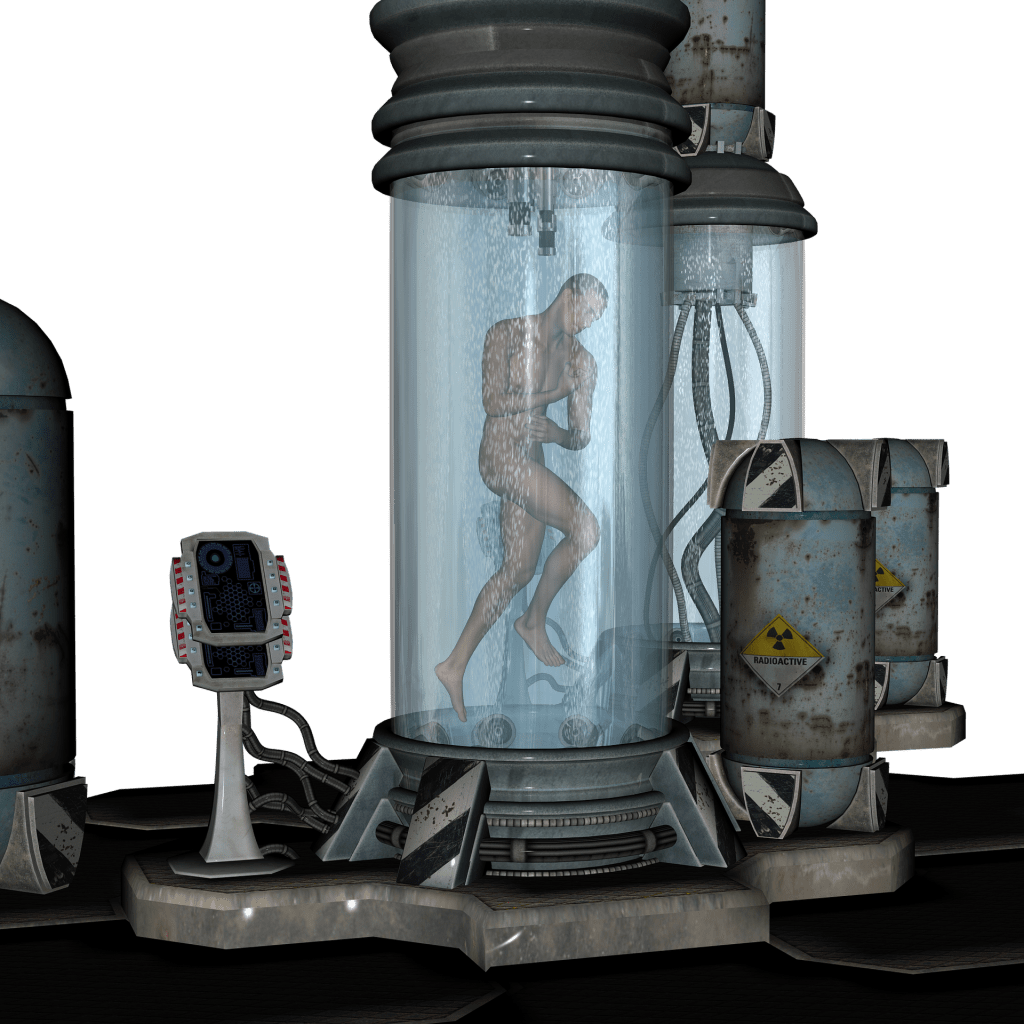
Brave New World, written in 1932, is science fiction. The first few chapters acclimate readers to the world of the story by oscillating between exposition and character introductions. The Director of the Central London Hatchetry and Conditioning Center, whose motto is “Community, Identity, Stability,” gives new students a tour of the facilities while we meet Bernard Marx, the intelligent yet underwhelming protagonist, and Lenina, the ditzy, beautiful woman he admires. As the narrative focus shifts between the student tour and character conversations, we learn things explicitly and incidentally. We learn explicitly (from the Director but also through Marx, who works there) the detached processes of human production in this world, ranging from laboratory breeding to Pavlovian response training to subliminal messaging during sleep. All these processes engineer a hierarchy of humans from leader Alphas to subordinate Epsilons. We learn incidentally (picking up on characters’ behaviors and convos) that ideas like family, love, envy, sadness, and attachment are alien to them. Most citizens are addicted to a “happy pill” called soma. They sleep around indiscriminately and speak of “trying” someone nonchalantly. There aren’t old people. Public entertainment, such as the movies, is intellectually empty and incorporates physical sensations through the release of pheromones. Every phrase we use “Lord” in, they use “Ford.” Oh, Ford. Thank Ford!
The conflicts begin when Marx, an Alpha who turned out short and ugly due to a mistake, takes Lenina, also an Alpha, on vacation outside “their world” to a reservation where life resembles today’s third-world countries, though the outsiders can access some “modern” things like literature. When Marx meets a boy and his mother and realizes the boy’s father is an important man from “his world,” he brings the family back to the society (parenthood is scandalously gross to the society). As John, who everyone ironically calls “Savage,” attempts to integrate with this “brave new world,” he uncovers the horror in exchanging freedom and passion for perpetual happiness in the form of unfettered hedonism.
[Side note: The first chapter made me so queasy I had to stop, which has never happened to me. It only happened once. I feel compelled to share that for those who are squeamish.]
Additional Details
Upstairs in his room the Savage was reading Romeo and Juliet.

The title of the novel comes from Shakespeare’s The Tempest. In Act V, Scene 1, Miranda says: O wonder!/ How many goodly creatures are there here!/ How beauteous mankind is! O brave new world,/ That has such people in’t.
The “Ford” references allude to Henry Ford, founder of Ford Motor Company; he sponsored the development of assembly lines for mass production. The World State, the entity that controls the globe in Brave New World, operates according to the principles that dictate assembly lines: mass production, homogeneity, predictability, and consumption of disposable consumer goods.
This novel was written between the two world wars. Hitler gained power in Germany the year following its publication. Prior to the first world war, many people thought society would only improve with time, but afterwards, those people felt disillusioned.
The structure of DNA had not been discovered when Brave New World was written, so genetic engineering isn’t part the story. [The structure of DNA was discovered in 1953.]
Thanks for reading! Have you read this one?



 Retrospective Lily
Leave a reply to Candace Hinnergardt Cancel reply